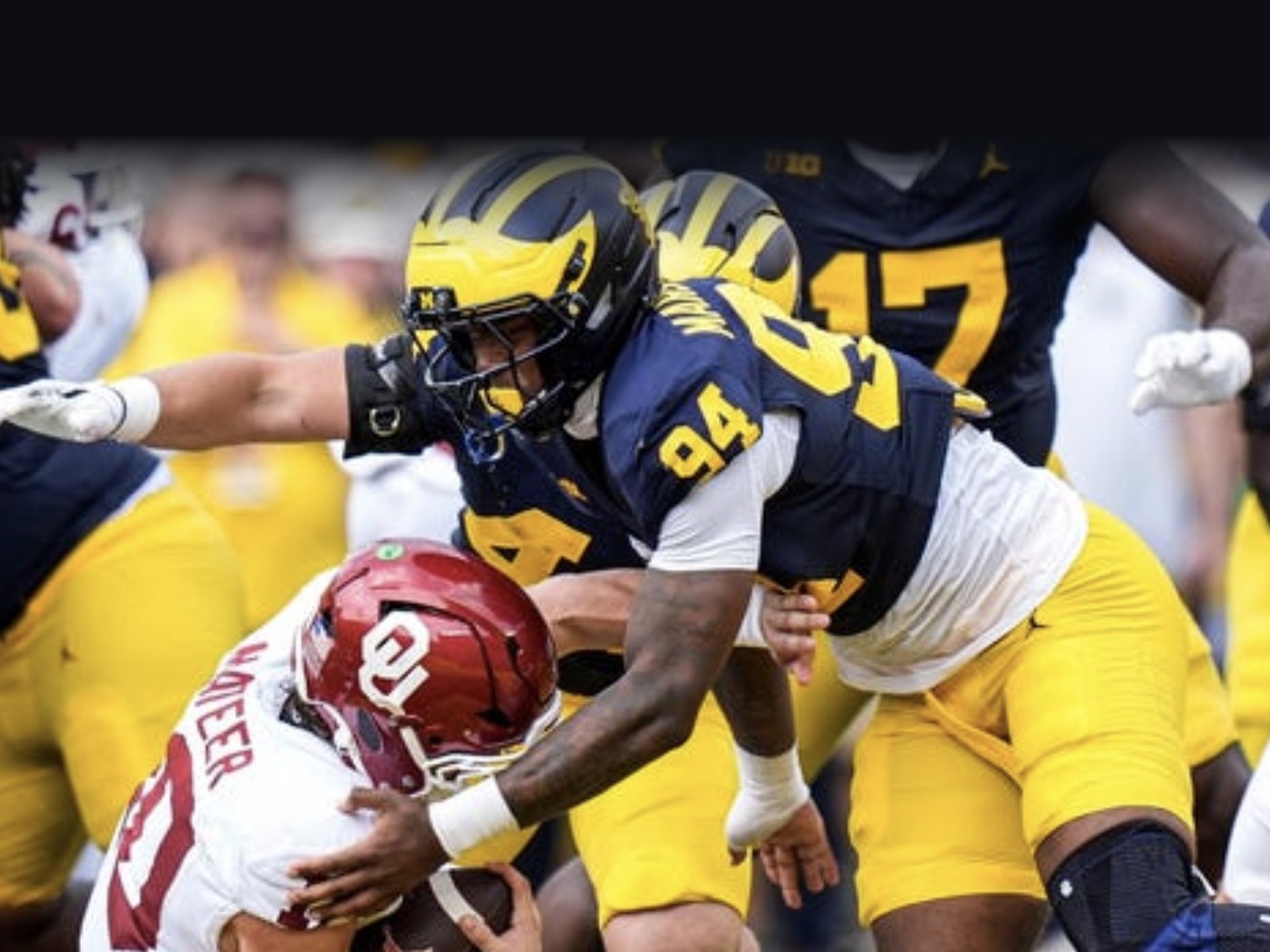
Three Big Ten playoff contenders went on the road Saturday to play unranked teams. All three lost. Michigan beat No. 4 UCLA 18-16 in triple overtime. Washington beat No. 8 Indiana 27-24 in overtime. Nebraska beat No. 14 Ohio State 31-28 in Lincoln.
The conference that won the last three national championships now has a real path to one seat in a 12 team field. The No. 3 team in the country beat an FCS opponent 47-0 and will likely stay No. 3. And the teams nobody wants to see in December are the ones peaking right now.
That is the whirlwind. Here is how it sorts out.
The Big Ten math nobody wanted
Start with the rules. The five highest ranked conference champions get in. Seven at large spots go to the next best teams. The top four in the committee's rankings get byes whether they win their league or not.
UCLA is 10-1 and still controls its road to Indianapolis. Beat USC at the Rose Bowl and the Bruins are in the Big Ten title game. The problem is under center. Ty Dieffenbach, who took over after starter Nico Iamaleava was lost for the season, was carted off on the first play of overtime in Ann Arbor. That puts the season in the hands of the third quarterback on the depth chart, Madden Iamaleava.
A backup is one thing. A third stringer against your rival, in the Rose Bowl, with a title game trip on the line, is something else. STRANOVA docks UCLA for the quarterback change and still makes the Bruins a slight favorite, about 52 percent. I put it closer to 10. A backup is a plot twist. A third stringer against your rival is a different movie.
Robert Griffin III made the case Bruins fans are making: UCLA played a playoff season and could get punished for who is left standing. The committee is allowed to weigh who is available. UCLA knows which way that cuts.
Ohio State is 7-4, its first four loss season since 2011. Ryan Day said afterward that "a lot of things have to change." The playoff is gone.
The one seat scenario takes two results. USC beats UCLA. Oregon wins the league. Then UCLA, Indiana and Iowa are all fighting for at large spots from outside the top 11, and the bracket math says that is where seats run out.
That would be a mistake. Measure every team's last four games against what each opponent normally scores and allows, and the two best teams in the Big Ten are Oregon and Iowa. Both belong in this bracket, and both could make noise in it.
The team nobody wants to see
Oregon was 4-3 on Oct. 25. That Sunday, a day after a 21-10 loss at Illinois, Dan Lanning fired offensive coordinator Drew Mehringer. The Ducks had scored 17 points or fewer in three straight games. ESPN's playoff predictor gave them a 2 percent chance.
They have not lost since. Northwestern 34-26. At Ohio State 41-28. Michigan 31-7. At Michigan State 45-7. ESPN now has them at 62 percent, the best chance of any Big Ten team.
Here is what makes the turnaround real. The quarterback did not change. Dante Moore has not played since he was hurt against USC on Sept. 26, and Lanning said in late October he is not expected back this season. Same quarterback room, new play caller. Put the last three games before the change next to the four since:
- Points per game: 14.0 before, 37.8 since.
- Against what those defenses usually allow: 5.5 points under before, 18.8 points over since.
- Net yards per dropback, sacks included: 4.8 before, 8.7 since.
- Against what those pass defenses usually allow: 1.4 yards under before, 3.0 yards over since.
- Average defense faced, ranked by points allowed and adjusted for schedule: 30th before, 34th since.
- Average pass defense faced: 48th before, 31st since.
That is a swing of about 24 points per game against defenses of the same caliber, and the pass defenses got tougher, not softer. Nothing about Oregon's roster changed. The offense did.
That is also the context for the worst line on Oregon's resume, a 39-31 loss at Oklahoma State in September. It is a bad look. It was also the old offense.
Over the last four games, Oregon ranks third of 138 FBS teams, behind only Georgia and Wake Forest. Its offense ranks second. Its defense has held those four opponents more than eight points under their normal output.
Rank the playoff hopefuls by how they are playing in November, not September, and you will not find many teams that want a bracket with Oregon in it.
About that win in Columbus
Some of the pushback on Oregon's resume comes down to one line: Ohio State did not have Julian Sayin. Look at what actually happened to Ohio State after Sayin went down in the fourth quarter at Indiana on Oct. 17.
The schedule turned. Through Indiana, Ohio State's opponents averaged the 69th best scoring offense in FBS, adjusted for schedule. In the four games since, they average 24th. The defenses got tougher too, from an average of 63rd to 28th.
The defense broke. Ohio State allowed 13.4 points per game through Indiana and held all seven opponents under their normal scoring. In the four games since, it has allowed 30.3 per game.
The offense bent, but it did not break. Ohio State's passing game fell from 10.0 net yards per dropback to 6.9 over those four games, and that is the cost of losing a quarterback like Sayin. But against much better defenses, the Buckeyes still scored about five points per game more than those defenses normally allow. In Columbus they scored 28 on Oregon, seven more than the Ducks usually give up.
Saturday in Lincoln made the point again. Nebraska's defense ranks 17th in FBS in points allowed, adjusted for schedule, and its pass defense ranks 16th. In its other games against FBS teams it allows 15.8 points per game. Ohio State scored 28, the most Nebraska has given up all season. The Buckeyes averaged 6.8 yards per play and 9.0 net yards per dropback. Measured against what each defense normally allows, that per play number beat Ohio State's average in the seven games through Indiana, and the passing number matched it.
Ohio State did that on 49 plays. Nebraska held the ball for 35 minutes, converted 10 of 16 third downs and went 2 for 2 on fourth down. Ohio State did turn it over twice. But an offense that scores 28 on a top 20 defense has done its part. The defense lost that game, the same way it lost to Oregon.
Now the Oregon side, and a simple question for Ohio State: has anybody else beaten you like that?
Ohio State led 14-0 late in the first quarter, in its own stadium. Then Oregon scored 38 straight points. It was 31-14 after three quarters, and ESPN's win probability had the Buckeyes at 3 percent. The game was over before the fourth quarter started. Two late Ohio State touchdowns made the final 41-28.
The answer is no. USC's biggest run against Ohio State was 10 straight points. Nebraska won by three. And Texas needed a touchdown with 25 seconds left. Nobody else has done to the Buckeyes what Oregon did in Columbus.
In its other 10 games this season, Ohio State's defense allows 17.4 points per game. Oregon scored 41. That is the most anyone has put on the Buckeyes this year, and 10 more than any other opponent.
Ohio State did not lose to Oregon because of who played quarterback. It lost because its defense could not stop Oregon's offense. Discounting the win on Sayin's account gets the game backward.
The games everybody forgot
Before anyone writes off the Big Ten, go back to Sept. 12 in Ann Arbor. Michigan beat Oklahoma 17-10.
Now look where both teams sit. Oklahoma is 7-4, fifth in the SEC at 5-3 and ranked 22nd by the committee, with wins over No. 5 Texas, at No. 24 Florida and over No. 25 Ole Miss. Michigan is 6-5 and 3-5 in the Big Ten, where 11 of the other 17 teams have a better conference record.
And on Saturday, that same Michigan team took down the Big Ten's top dog. UCLA came to Ann Arbor 10-0, alone in first place in the conference and No. 4 in the country. It left with its first loss.
Put it plainly. A top third SEC team, ranked by the committee, lost to a bottom third Big Ten team. And that bottom third Big Ten team just beat the No. 4 team in the country. Outside of a 31-7 loss at Oregon, nobody has beaten Michigan by more than nine. Iowa won 20-19 on a touchdown on the final play. Indiana needed overtime to win 13-6. Michigan is anything but an easy out, and it is sitting in the bottom third of the standings.
And while we are on Texas, here is another data point. On Sept. 12, Ohio State went to Austin and controlled the game. The Buckeyes led for all but the first 2:56 and the final 25 seconds, about 94 percent of the game clock. They were up 23-3 late in the third quarter, when ESPN's win probability had them at nearly 99 percent. Texas needed 21 fourth quarter points and a touchdown with 25 seconds left to win 24-23. Texas is No. 5 in the country. That Ohio State team is now 7-4 and in a three way tie for fifth in the Big Ten.
One game is one game. Two start to look like a pattern. When a bottom third Big Ten team beats the team that beat Texas and then beats the team in first, and a team tied for fifth in the Big Ten holds the lead in Austin for 94 percent of the game, the Big Ten is not the soft spot it is being sold as. Saturday said the same thing. The two teams that took down Indiana and Ohio State, Washington and Nebraska, are both 7-4.
Iowa does not care, and that is the point
Iowa beat Illinois 34-17 for its fourth straight win. ESPN's Adam Rittenberg pointed out the Hawkeyes have outscored those four opponents 116-34. Asked about the committee, Kirk Ferentz said, "I could care less about those guys." That is the most Big Lebowski thing a head coach has said all year. The Dude abides, and so does Iowa.
Start with the defense. Iowa allows 13.4 points per game against FBS teams, third fewest in the country. Adjusted for schedule, its run defense ranks second of 138. It has shut out two FBS opponents, Northern Illinois and Wisconsin, and during the four game streak it has allowed 8.5 points per game.
The run game is what makes it go. During the streak Iowa has run the ball about 42 times a game for 210 yards, up from about 30 carries and 142 yards a game before it. And the results follow the run game. In the five games Iowa ran for 5 yards a carry or more against FBS teams, it won all five, every one by 14 points or more. In the four games it ran for under 3.3 a carry, it went 2-2, and the two wins came by one point and three. Both losses, to Ohio State and Minnesota, came in that group. The one game in between was a 30-0 win over Wisconsin.
That is the formula that travels in December. Since 2021, in FBS games still within eight points entering the fourth quarter, the team that ran for more yards per carry and did not lose the turnover battle won 72 percent of the time. Teams that run it and stop it are miserable to play, and they get more miserable in the playoffs, when every game is close. Iowa already stops the run as well as anyone in the country. If it keeps running it like this, nobody wants that draw.
Iowa also owns a 41-24 win at Washington, the team that knocked off Indiana Saturday. Nebraska, the team that knocked off Ohio State, comes to Iowa City on Friday. Win that and Iowa owns wins over both of this week's Big Ten giant killers.
Do not sleep on Indiana
This is not last year's 16-0 team. The quarterback spot has been unsettled since Josh Hoover hurt his shoulder against Ohio State in October. Grant Wilson took over against Minnesota and started the last two games, and Hoover came back in during the second half at Washington.
Indiana should not fall far for losing by three in overtime on the road. Look at how this team loses: 19-15 to Ohio State and 27-24 at Washington. Nobody has beaten the Hoosiers by more than four points. Indiana is one of five FBS teams ranked in the top 25 in both run offense and run defense, adjusted for schedule, and one of only three in the playoff picture, with Georgia and UCLA. Its defense ranks fifth in the country in points allowed.
What Indiana lacks is a signature win. Its best is a 27-13 home win over USC, ranked 18th last week. That, more than Saturday, is what stands between Indiana and a seat.
Washington did run for 7.7 yards a carry on Saturday, so the front has something to fix. But a team coached this well and this good in the trenches does not get blown out. Sort out the quarterback, and Indiana is a tough out for anybody.
White Hot Demon Deacons
Wake Forest is deciding games before halftime. In its last four games against FBS teams, the Demon Deacons led at the break 34-0 at Cal, 20-0 against Virginia, 42-0 at SMU and 36-7 at Georgia Tech. That is 132-7 in first halves. On Saturday in Atlanta it was 29-0 before Georgia Tech scored.
Measured against what each opponent normally does, only Georgia has played better than Wake Forest over the last four weeks. This team is peaking at exactly the right time.
What it does not have is a signature win. Its best is a 30-27 win at Louisville, ranked 23rd last week. Its only loss is 33-20 at home to Miami, and Miami is waiting again in the ACC title game in Charlotte on Dec. 5. Win, and Wake Forest is the ACC champion and in. Lose to the same team twice with no signature win to point to, and Wake could be on the outside looking in.
Alabama is the closest thing to fool's gold
Fool's gold does not mean Alabama is not a playoff team. It means the No. 3 next to its name does not hold up to the resume. The committee has had the Tide at No. 3 since Nov. 10, and Saturday's 47-0 win over Chattanooga does not change the argument either way.
Here is the problem. Alabama's only two wins over teams in last week's rankings took losses Saturday. Kentucky lost 28-14 at Missouri. South Carolina lost 34-6 at home to Georgia. Both could fall out of Tuesday's rankings. If they do, the No. 3 team in the country will own zero wins over the committee's own Top 25.
Now put Alabama next to the team ranked six spots behind it.
- Head to head: Tennessee 26, Alabama 10, in Knoxville.
- Wins over teams in last week's rankings: Tennessee beat No. 3 Alabama and No. 16 Kentucky. Alabama beat No. 16 Kentucky and No. 21 South Carolina.
- Losses: Tennessee lost 20-17 to Texas and 27-24 at South Carolina. Alabama lost 20-17 to Georgia and 26-10 at Tennessee.
Tennessee has never lost by more than three. Its loss at 6-5 South Carolina is a real mark. It is not a 16 point loss to the team you are being ranked ahead of.
Tim Tebow put it plainly on SEC Network: "The problem is they played a game for 60 minutes." That clip has passed 800,000 views on X.
It is head scratching that this has lasted two releases, and if Alabama sits at No. 3 again Tuesday, it is officially Groundhog Day. Head to head is the only piece of evidence where two teams played the same opponent, on the same field, at the same time. My view: swap them. Tennessee's resume belongs in the top five. Alabama's belongs in the field, somewhere in the 7 to 10 range. Not No. 3.
Utah answers every bell
Utah beat TCU 38-17 and is 11-0, the last unbeaten team in FBS. The final score lies.
This one had letdown written all over it. A week earlier, Utah survived an emotional 40-39 thriller at Arizona, a game where the lead changed hands seven times and the Utes trailed 39-33 with 3:13 left before a 70 yard touchdown pass won it with 2:35 to go. Then it was back on the road for a second straight week. That is the spot where even good teams come out flat. Utah came out and jumped all over TCU instead, up 17-0 at halftime. That is a team that is locked in.
From there TCU, one win from bowl eligibility and playing like it was the Super Bowl, scored 17 straight and tied it on a field goal with 9:26 left. Then Utah throttled them. Three touchdowns in the final 5:46. Pressed, on the road, in a tie game in the fourth quarter, the Utes did exactly what good teams do.
That is the test I care about most. Anybody can win at home on a sunny afternoon. The ultimate tests in college football come on the road, and at neutral sites when conditions are not set up for you. The crowd is loud, the call goes the wrong way, the other team is playing the game of its life. How does your team respond when everything is going against it? What signature road wins do you have?
Utah is 5-0 away from home. It won 27-24 at Colorado. It won 40-39 at Arizona, ranked 23rd at the time, and turned around and won at TCU a week later after giving up 17 straight. Only three teams in the country have not lost away from home: Utah, Georgia and Wake Forest. Only one of them has not lost anywhere. Utah is the only team in the country that has answered the bell every single time.
Georgia is 10-1 and has been No. 1. The case for Georgia is the win over Alabama and a 34-6 road win at South Carolina. The case for Utah is shorter. Nobody has beaten it.
Both are headed for byes if they hold. The fight is over the No. 1 seed, and Utah gets two more chances to make it: West Virginia this week, then the Big 12 title game. It will be the last one. Next year's 24 team playoff ends Power 4 championship games.
The bubble
Welcome to the Hunger Games. Texas Tech is 10-1 after a 20-10 win at Baylor. BYU is 9-2 after needing three overtimes to win at 4-7 Kansas. The game was 16-16 after regulation.
Both are sitting near the cut line, and both get squeezed if a Big Ten champion or a Group of Six champion jumps the line. The cleanest path for each is the same: win the conference title game and stop asking the committee for anything.
The seat outside the Power 4
Boise State lost 22-20 at home to San Diego State. Liberty is 10-1 after a 45-14 win over Western Kentucky, but its schedule ranked 135th nationally as of last week. Whichever champion outside the Power 4 the committee ranks highest takes a seat. Someone on the bubble pays for it.
Rivalry week: the games that move the board
- Nebraska at Iowa, Friday. Iowa's chance at a second statement win.
- USC at UCLA. Win and UCLA is in the Big Ten title game. Lose and the league's race opens up.
- Washington at Oregon. The hinge of the Big Ten race. STRANOVA ran all 512 ways the final week can go, and an Oregon win sends the Ducks to Indianapolis 96 percent of the time.
- Indiana vs. Purdue. The champions need a win and help.
- The Iron Bowl. Alabama's last chance to add a quality win before Selection Day.
- Texas at Texas A&M. Texas has a top four seed in reach.
- Michigan at Ohio State. Michigan already took UCLA's unbeaten season. Now it gets the Buckeyes in Columbus.
Bring on 24
Remember everyone who said the 12 team playoff would be bad for college football? Look around.
Three Big Ten contenders went down in one afternoon. A team that fired its offensive coordinator in October is the hottest team in its league. A head coach told the committee he could care less. Wake Forest has outscored its last four FBS opponents 132-7 in first halves. Utah is chasing a perfect season. Alabama is sitting at No. 3 with a resume that needs a second look. Every fan base in America has a reason to watch Tuesday night.
And last year the bracket gave us Indiana, the program with the most losses in college football history, running through it for a national title. Under the old four team format, that story never gets written.
I embraced the 12 team playoff, and I am going to embrace the 24 team playoff just the same. Could the format use some tweaking? Of course. Does it give more teams real access? Of course. With the parity in this sport right now, we are building something closer to March Madness than anything the BCS ever dreamed of. More teams than ever have a chance to make a run. You might get your Cinderella. Before, that was never going to happen.
Next year the Power 4 title games go away and Selection Day moves to the Sunday after Thanksgiving. J.D. PicKell pointed out that this Ohio State team would make next year's field. That is the trade. For one more season, a loss still costs you something. Saturday proved it three times.
Enjoy the chaos. It is the best show in sports.
How we measured it: every number compares a team's game to what that opponent does in its other games against FBS teams, through Nov. 21. Ranks are among 138 FBS teams. FCS games are left out.