Every fall, the SEC drops its trailer, the music swells, and the whole country nods along like it already saw the movie. This year the nodding got louder.
Let me be clear about what I'm saying. I'm not telling you the Big Ten is better. I'm telling you it's close, and that "the SEC is definitively better" is carrying a lot more confidence than the evidence can support.
The two leagues played each other three times this season, all on the same Saturday, Sept. 12. The SEC won two. Let's run the tape.
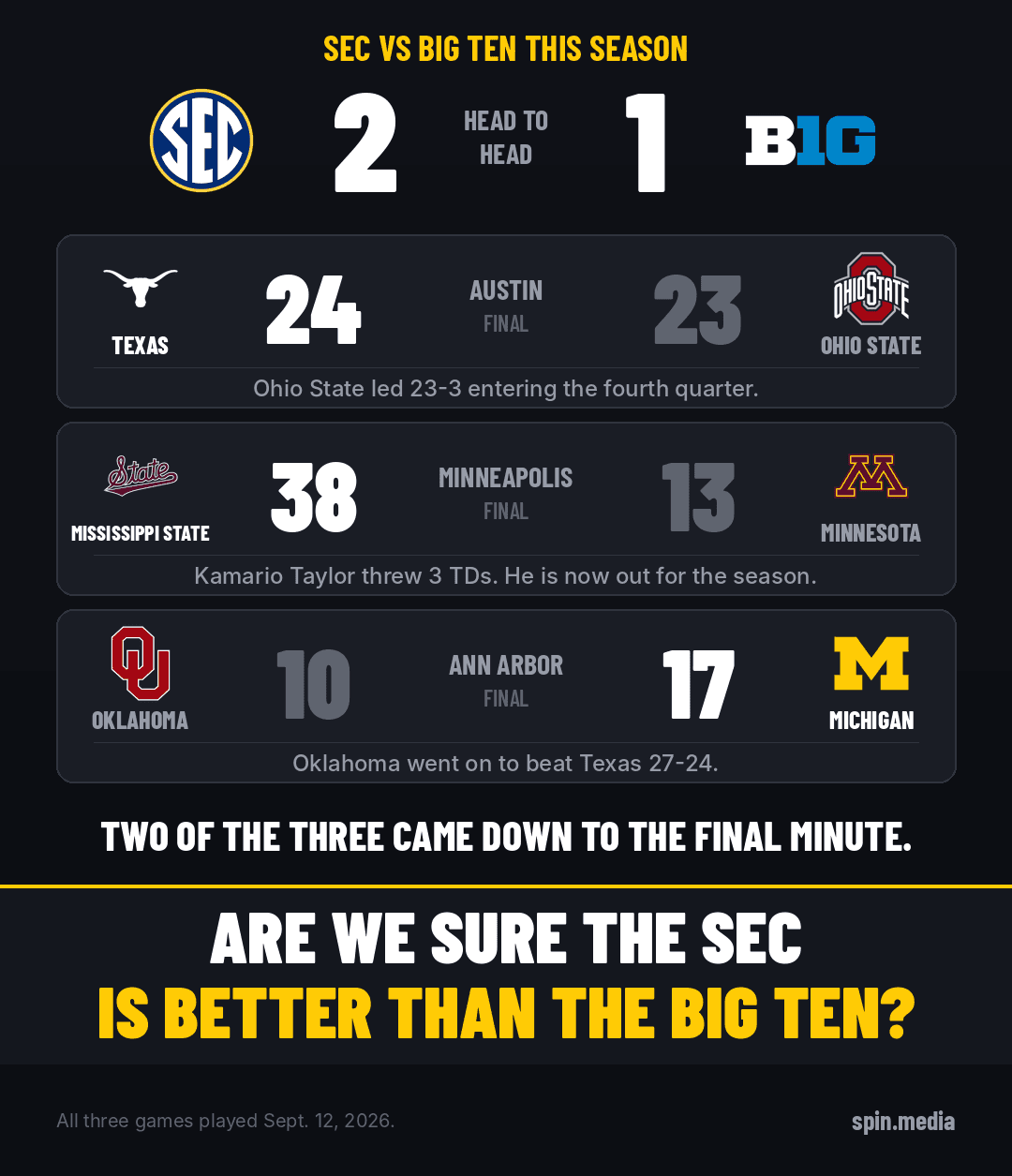
Texas 24, Ohio State 23
Credit Texas. It found a way. But look at the game Ohio State played in Austin.
Ohio State led for about 94 percent of the game clock. It was up 23-3 going into the fourth quarter, and its win probability peaked near 99 percent. Then Texas went full Rocky in the final round: 21 straight points and a 1-yard touchdown run with 25 seconds left.
Great comeback. Love it for them. It's also one result, at home, in Week 2. Play that game in Columbus or on a neutral field and I don't think anybody bets on the same ending.
Now look at who Texas beat. Ohio State is 7-4 and 5-3 in the Big Ten, tied for fifth with USC and Wisconsin, behind UCLA, Indiana, Iowa and Oregon. That's a middle of the road Big Ten team. One of the SEC's best teams needed the final 25 seconds, at home, to beat it by a point. That isn't a gap between leagues. That's a close game with great lighting.
"But Ohio State lost its quarterback"
Fair point. Julian Sayin hurt his throwing shoulder in the fourth quarter of the 19-15 win at Indiana on Oct. 17 and hasn't played since. Ohio State was 6-1 with him and is 1-3 without him.
Look closer, though. With Sayin, Ohio State's schedule included three of the worst defenses in FBS: Ball State, Kent State and Maryland. Since he went down, it has seen USC, Oregon, Northwestern and Nebraska. The average defense it faced went from about 63rd in the country to about 28th. The Buckeyes didn't fall off. The schedule went from a Hallmark movie to a horror franchise.
Line the games up against defenses of the same quality and the drop mostly disappears. Against top 20 defenses, Ohio State scored about 10 points more than those defenses usually allow with Sayin (Texas, Iowa, Indiana) and about 10 more without him (Oregon, Nebraska). The record changed because the schedule changed.
The Oregon game makes the point. Oregon led 38-14 with 12 minutes left in the fourth quarter and won 41-28. Nobody else has handled the Buckeyes like that this season. Their other three losses came by 12 to USC, 3 to Nebraska and 1 to Texas. And Ohio State's offense wasn't the problem that night. It scored 28, more than Oregon's defense usually gives up. The defense gave up 41. A healthy Sayin doesn't fix that.
Mississippi State 38, Minnesota 13
This one was a beating, and Mississippi State earned it on the road. Kamario Taylor went 16 of 22 for three touchdowns, and the Bulldogs outgained Minnesota 479 to 292.
You're going to hear people lump this in with Ohio State: both teams lost a star quarterback, so treat them the same. Respectfully, no. The only thing these two situations have in common is the position. Everything else is a different movie.
- What the offense did after. Ohio State's offense against good defenses is about where it was with Sayin. Mississippi State's offense is scoring roughly 25 points fewer against defenses of similar quality than it did with Taylor.
- The record. Mississippi State started 4-0 and is 1-6 since Taylor got hurt. Ohio State is 1-3 since Sayin went down, and those losses came against a much tougher run of defenses.
- The rest of the lineup. Mississippi State also lost its lead back, Fluff Bothwell, on his first carry against Alabama. Ohio State lost a quarterback. Mississippi State lost its offense.
- The timeline. Taylor hurt his lower leg in the fourth game, a win over Missouri. He played hobbled against Alabama, missed LSU, left the Oklahoma game in the first quarter and was ruled out for the season in late October.
Here's the part that should make everybody laugh. Even the playoff committee treats September Mississippi State as a different team. As of its Nov. 10 rankings, it was still counting Alabama's 56-23 win over Mississippi State as a quality win, and committee chair Hunter Yurachek explained why: "when they had Kamario Taylor on their team, they were 4-0."
Except Alabama never saw that team. Taylor came into the game hurt from the week before, was sacked five times and was pulled early in the fourth quarter. Bothwell was in a boot by the second half. The committee graded the movie poster, not the movie. Alabama got credit for beating the healthy version of a team that showed up on crutches. Hearing that explanation, I have to ask: did anybody on the committee actually watch the game?
So pick one. If September Mississippi State counts as a quality win for Alabama, then September Mississippi State was a good team, and losing to it in Week 2 is no knock on Minnesota. Either way, the Mississippi State that sits near the bottom of the SEC today is not the one that played in Minneapolis, and that game tells you very little about where the two leagues stand now.
The Cleanest Comparison: Michigan 17, Oklahoma 10
That leaves the one game where both teams look like they did in September.
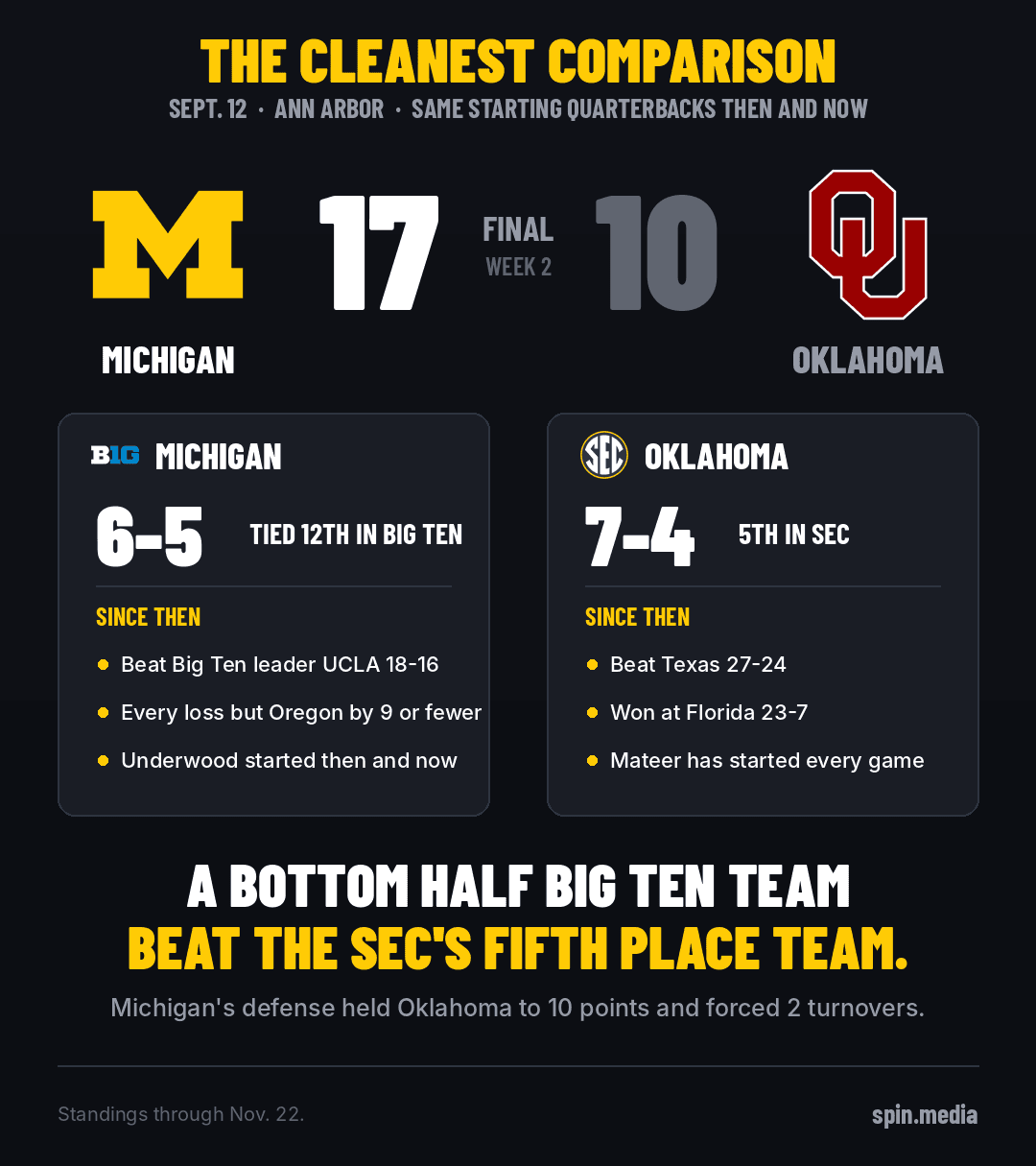
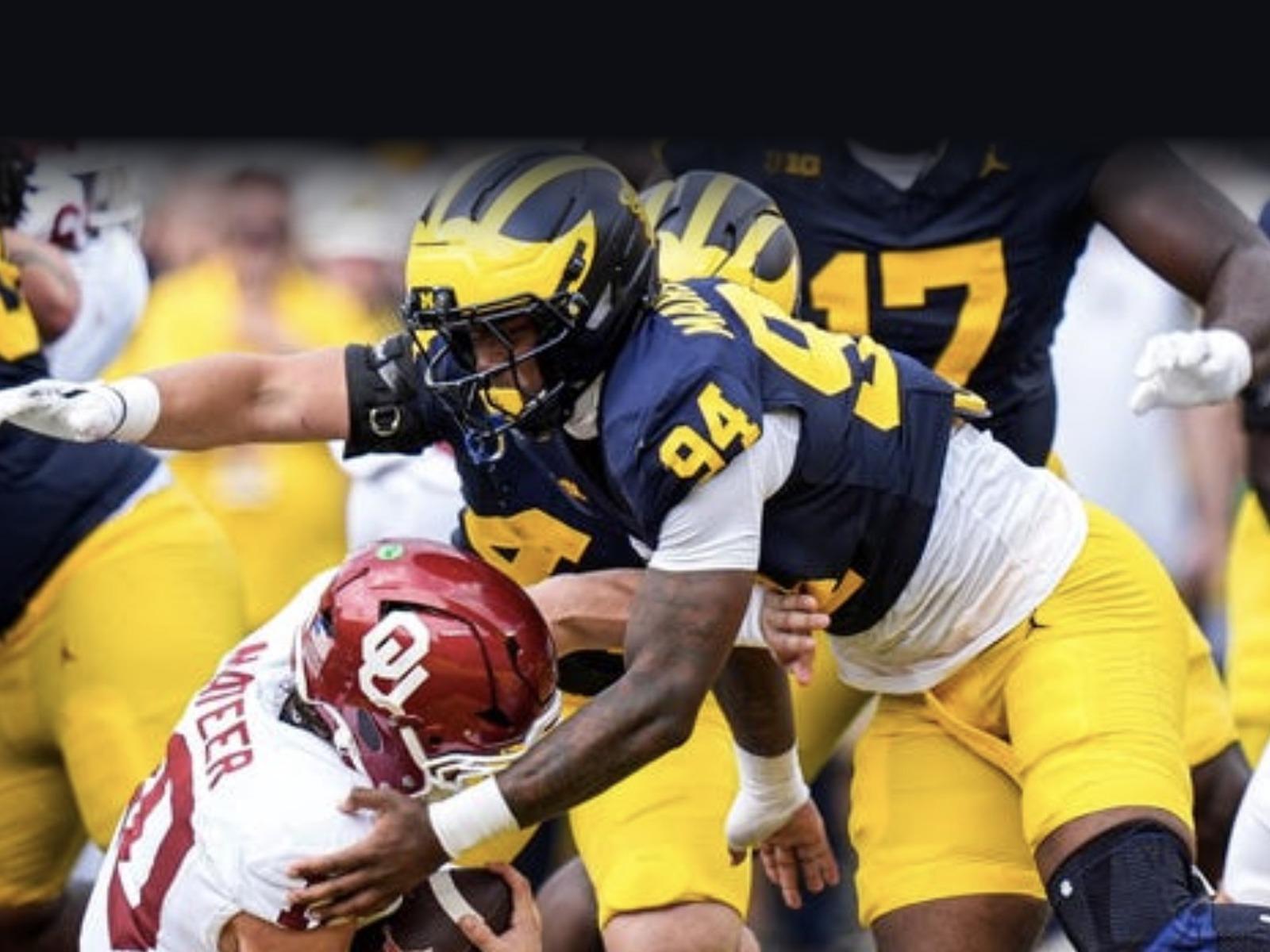
Oklahoma's John Mateer has started every game this season. Bryce Underwood started for Michigan that day and started again last week. Michigan's defense held the Sooners to 10 points and forced two turnovers, and an interception by Jyaire Hill set up the go-ahead touchdown. Oklahoma did lose star linebacker Kip Lewis to a knee injury in the first quarter, and that mattered. Michigan's offense still managed only 263 yards. The defense won that game. Full stop.
Now look at what both teams did after.
Michigan is 6-5, tied for 12th in the Big Ten, a bottom half team in the league. It is also the most chaotic team in America. Outside of a 31-7 loss at Oregon, every Michigan loss has come by nine points or fewer: 1 to Iowa, 6 at Minnesota, 7 to Indiana and 9 to Michigan State. Last Saturday it handed UCLA, the Big Ten leader, its only loss, 18-16. A couple of weeks earlier it handed Michigan State its only Big Ten win. Michigan beat the top of the conference and lost to the bottom of it. That season was written by Christopher Nolan, and you need to watch it twice to follow it.
Oklahoma went on to beat Texas 27-24, won at Mississippi State, won at Florida 23-7, and has beaten Ole Miss and Texas A&M in its last two games. It's 7-4, fifth in the SEC, and has won three straight. That's a real football team.
So a bottom half Big Ten team beat the SEC's fifth-place team, and that SEC team is good. If the gap between these leagues were as wide as the hype says, that result doesn't happen.
The Best Case for the SEC
I'm not going to pretend the other side has nothing. The SEC has the better record outside its own league this season. Against Power 4 teams and Notre Dame, the SEC is 10-2 and the Big Ten is 4-10, including 0-3 against Notre Dame. That's a real edge, and the SEC earned it.
But the head-to-head games are the most direct evidence we have, and they say these two leagues are close. One went to Texas in the final minute at home, against a middle of the pack Big Ten team. One went to a Mississippi State team that no longer exists. One went to a Big Ten team from the bottom half of its conference, against an SEC team from the top third.
That's not a gap. That's a coin flip with a better marketing department.
The Verdict
The SEC might be better this year. "Definitively" is where it falls apart. Two of the three head-to-head games were one-possession finishes, and the clearest one went to the Big Ten.
Definitively better? Not even close. Close? Definitely.
Are we sure the SEC is better than the Big Ten? I'm not. And the evidence says you shouldn't be either.
How we measured it: each offense is compared to what each opponent's defense allows in its other games, using every FBS game through Nov. 21. Defense rankings adjust for the offenses each defense has faced. Standings through Nov. 22.
Opinions expressed in this column are the author's own and do not necessarily reflect the views of Sports Idol Nation, its partners or its sponsors.