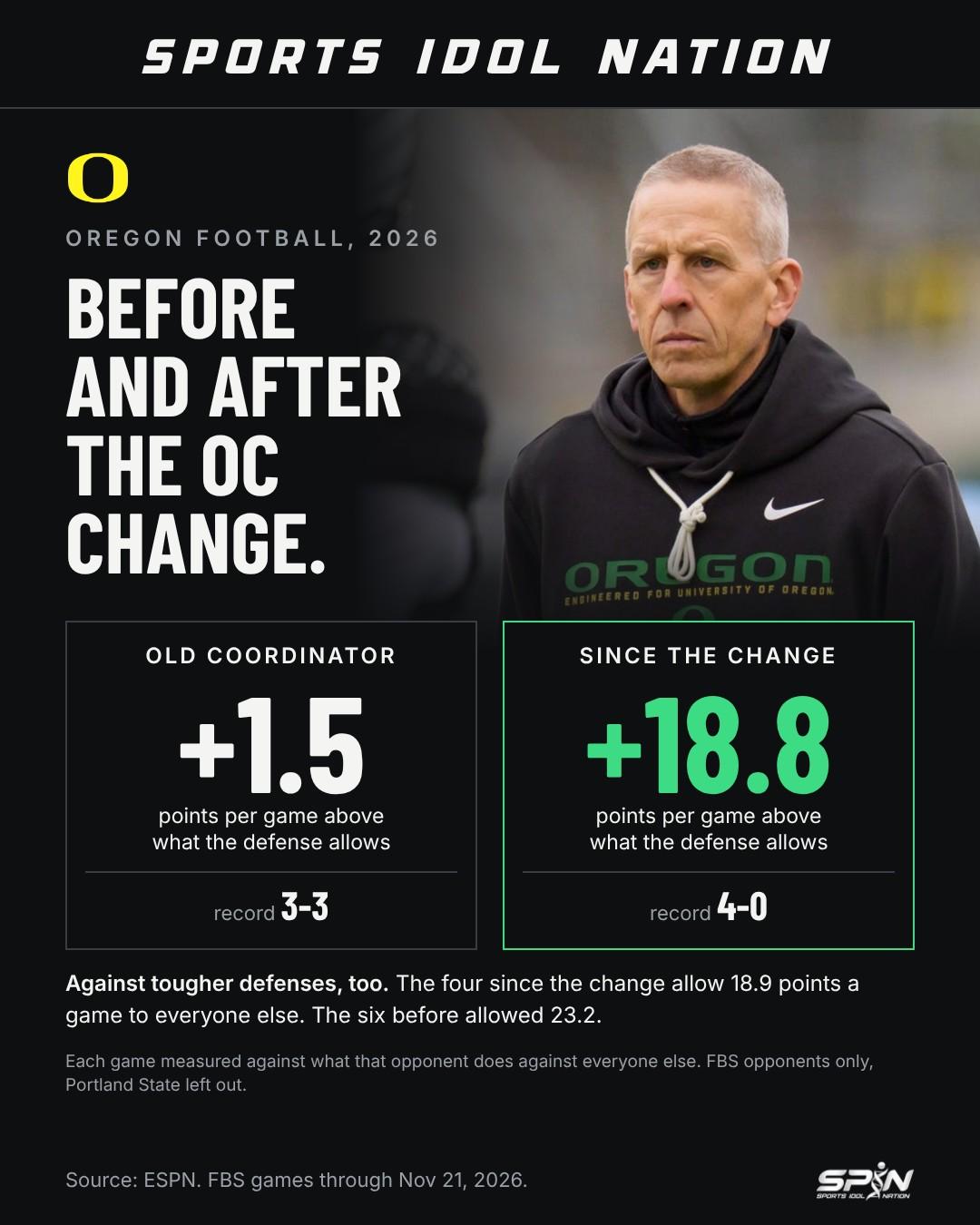
Oregon fired offensive coordinator Drew Mehringer on Oct. 25, the day after a 21-10 loss at Illinois. The Ducks were 4-3, and they had scored 17 or fewer points in three straight games. Assistant quarterbacks coach Jay Johnson took over play calling.
They have not lost since. Oregon beat Northwestern 34-26, won 41-28 at Ohio State, beat Michigan 31-7 and won 45-7 at Michigan State. Washington comes to Autzen Stadium on Saturday.
Four wins is the easy part to see. The harder question is whether the offense actually changed, or whether the schedule did. So we measured every game the same way.
How we measured it
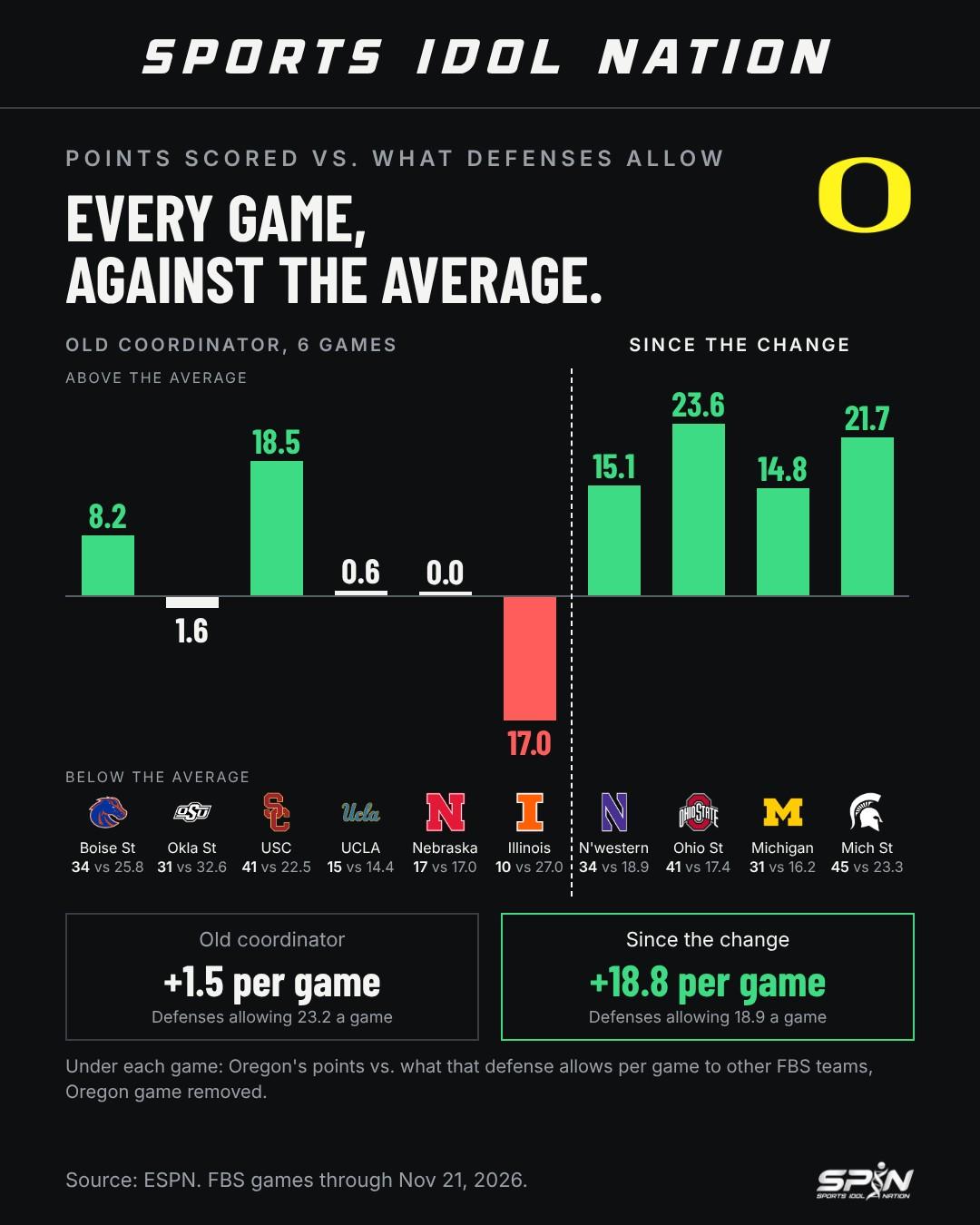
Every game is compared with what that opponent does against everyone else. If a defense usually allows 17 points a game and Oregon scores 41, that counts as 24 above average. The Oregon game is taken out of each opponent's average, and only games against FBS teams count. Portland State, an FCS team, is left out.
That gives six FBS games under the old coordinator and four since the change.
Scoring: from average to dominant
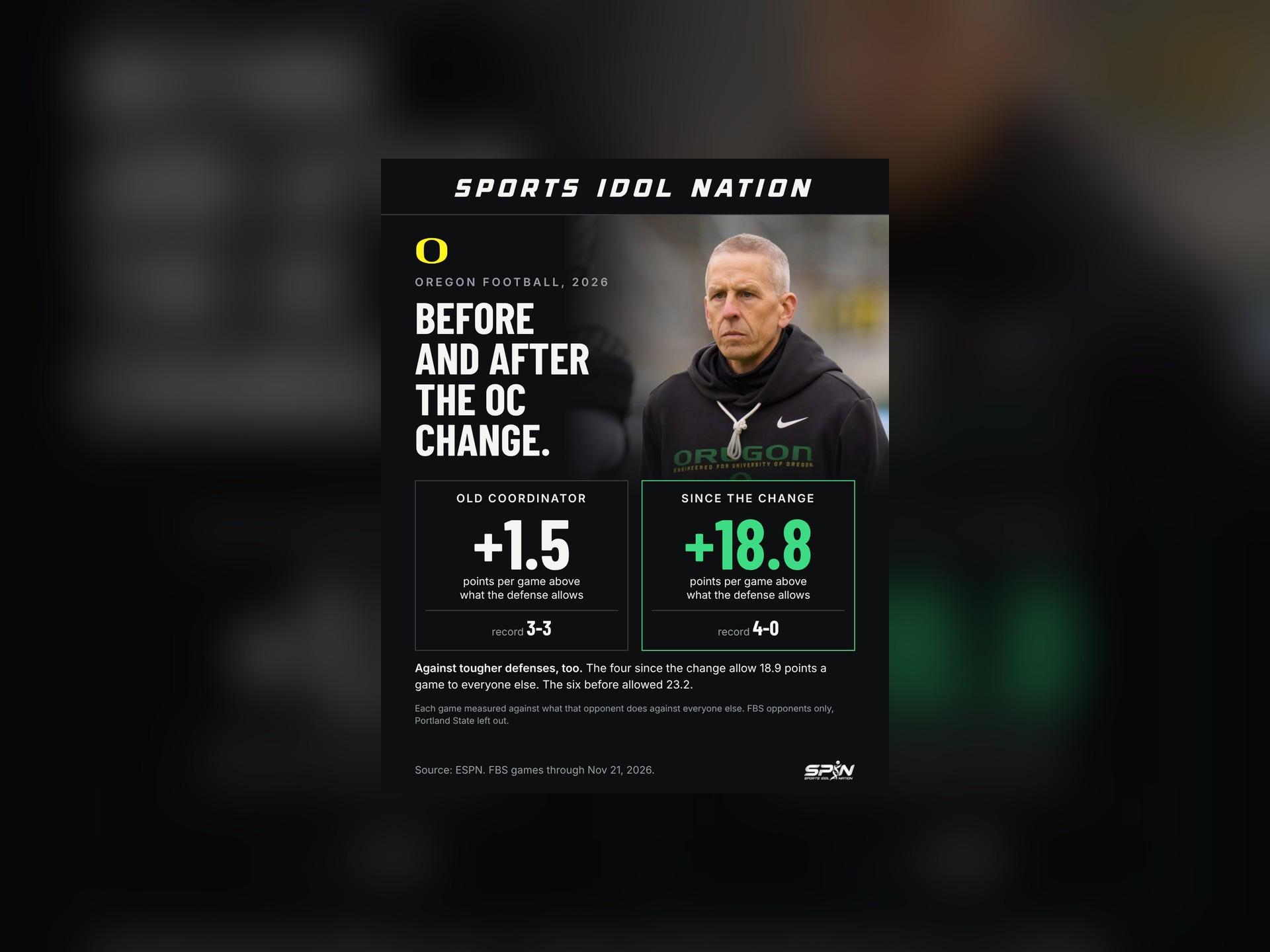
Under the old coordinator, Oregon scored 1.5 points a game more than its opponents usually allowed. That is an average offense. Oregon went 3-3 in those games.
Since the change, Oregon has scored 18.8 points a game more than its opponents usually allow, and it is 4-0.
The schedule did not get easier. The four defenses Oregon has faced since the change allow 18.9 points a game to everyone else. The six before allowed 23.2. Oregon is scoring more against better defenses.
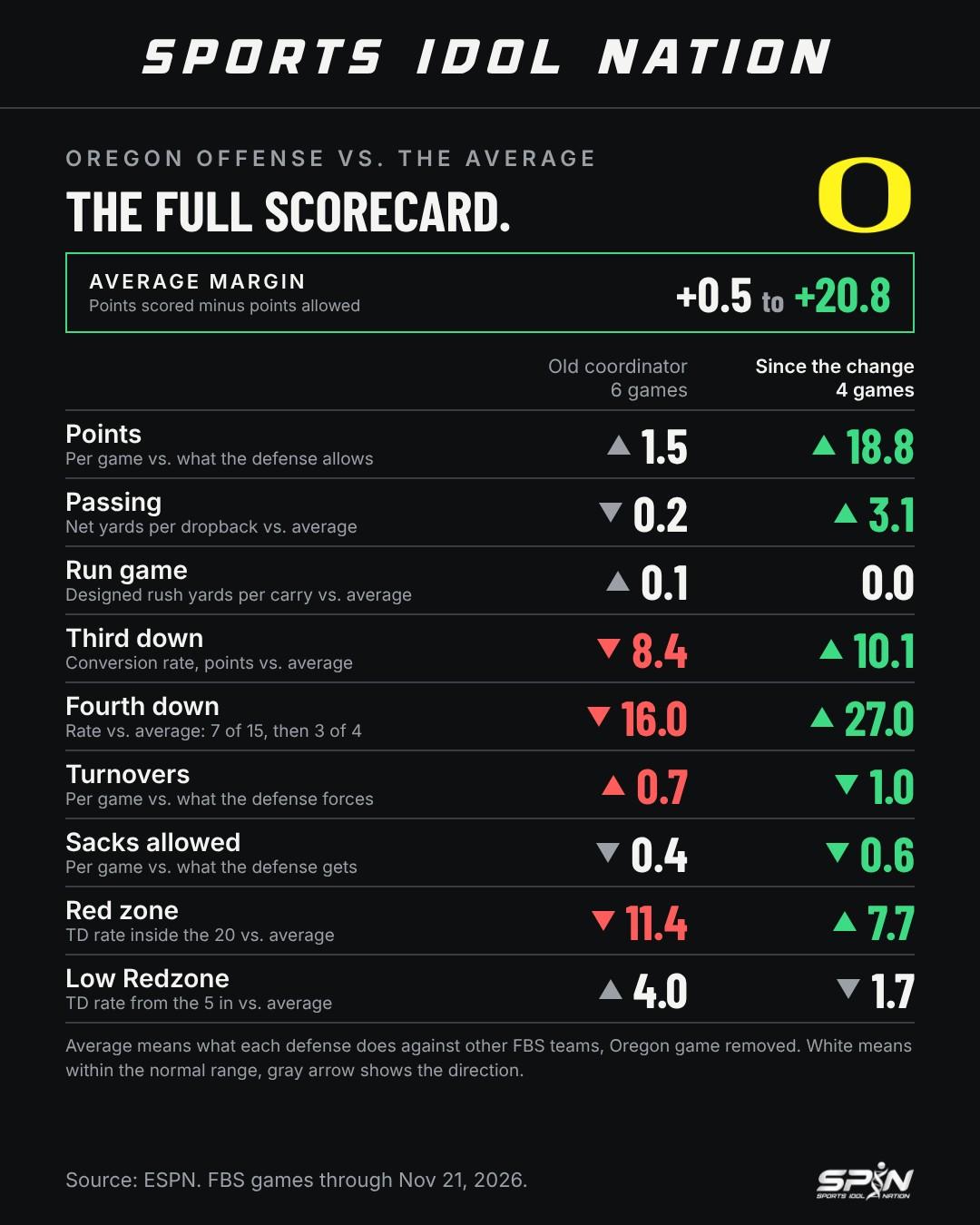
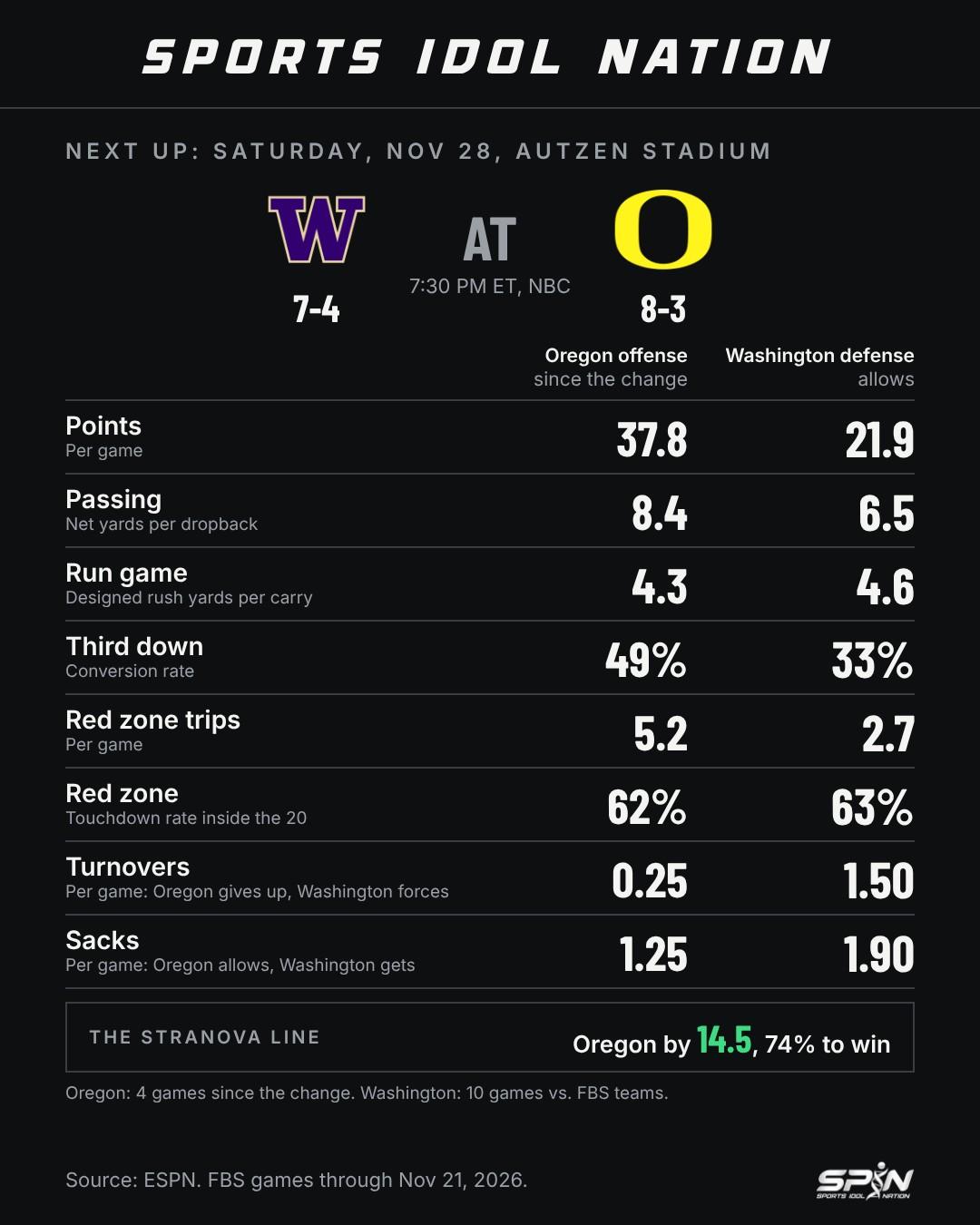
The raw numbers tell the same story. Oregon averaged 24.7 points in those six FBS games and 37.8 in the four since. The average margin went from 0.5 points a game to 20.8.
Where it changed
Third down. Oregon converted third downs 8.4 percentage points below what its opponents usually allow before the change. Since, it is 10.1 points above. No category moved more.
Turnovers. Before the change, Oregon gave the ball away 0.7 times a game more than its opponents usually force. Since, it is 1.0 fewer.
The passing game. Before the change, Oregon's net yards per dropback were 0.2 below what its opponents usually allow. Since, they are 3.1 above.
The run game has not moved. Oregon's designed runs were about average before the change and are about average now.
Fourth down. Oregon converted 7 of 15 fourth downs in the six games before the change and 3 of 4 since. That is a small sample.
Finishing drives
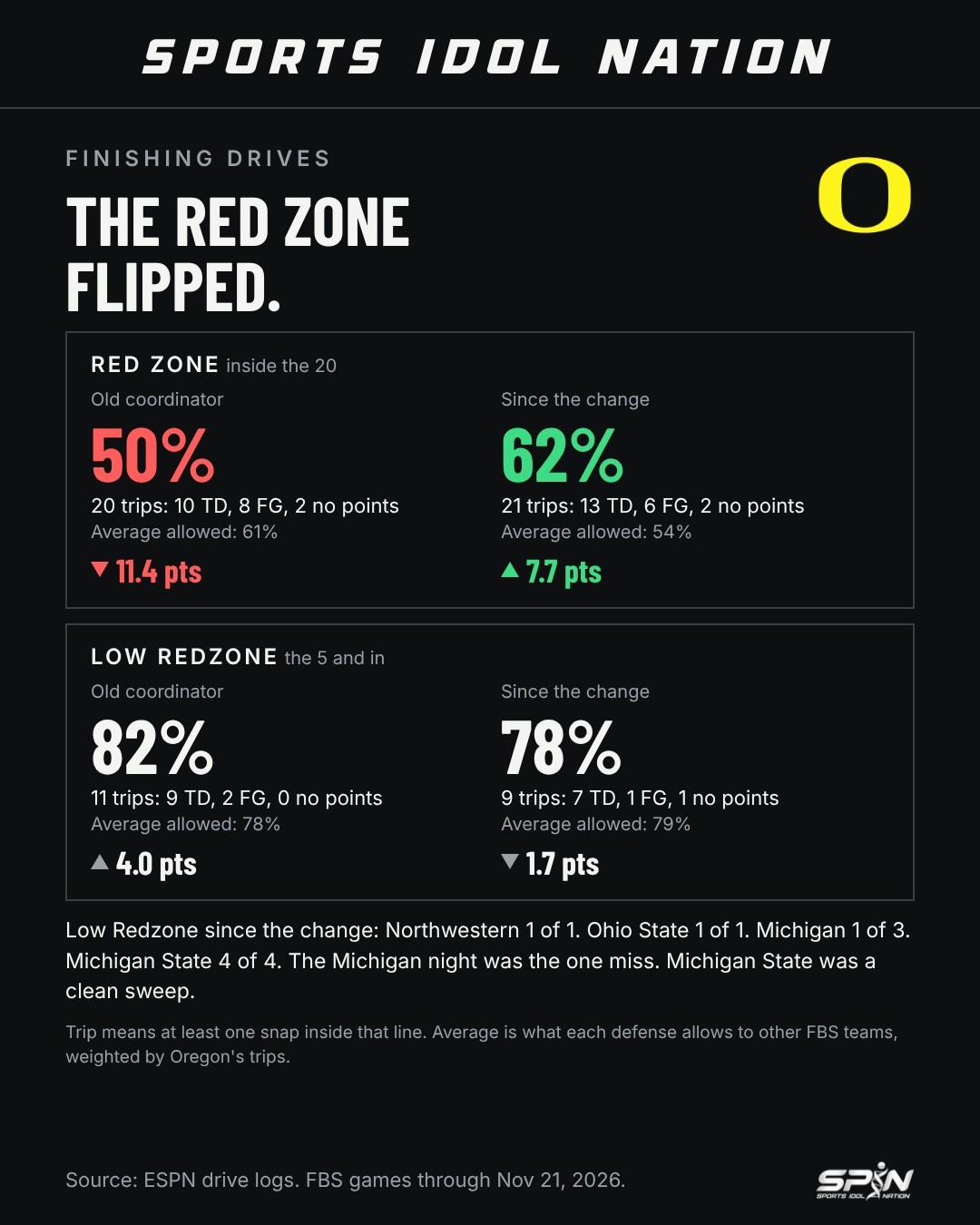
Oregon reached the red zone 20 times in the six games before the change. It scored 10 touchdowns and kicked 8 field goals. That is a 50 percent touchdown rate against defenses that usually allow 61 percent.
In the four games since, Oregon has 21 red zone trips, 13 touchdowns and 6 field goals. That is 62 percent against defenses that usually allow 54 percent.
The one rough red zone night since the change came against Michigan: three drives reached the 5 or closer, and only one ended in a touchdown. Oregon still won by 24.
The quarterback question
The coordinator was not the only change this season. Dante Moore took a late hit in the second quarter at USC on Sept. 26 and has not played since. He is expected to miss the rest of the season. Brock Thomas and Dylan Raiola split time in the next two games.
Raiola started the loss at Illinois, the game right before the change, and he has been the quarterback in all four games since. With the same quarterback on both sides of the change, the jump from 10 points at Illinois to 34, 41, 31 and 45 is hard to pin on the quarterback alone.
What comes next
Washington (7-4) visits Autzen on Saturday at 7:30 p.m. ET on NBC.
Washington's defense allows 21.9 points a game in its 10 games against FBS teams. It holds offenses to a 33 percent conversion rate on third down, and it has forced 15 turnovers.
SPIN's STRANOVA model has Oregon by 14.5, with a 74 percent chance to win.
About these numbers
Game results, box scores and drive data are from ESPN, checked against CBS Sports, official school box scores and CFBStats. A red zone trip is a drive with at least one snap inside the opponent's 20. Opponent averages use each team's other games against FBS opponents through Nov. 21, 2026. The STRANOVA line is the locked pick published before Week 13.